Introduction: The Overlooked Blind Spot in Quality Control
On production lines for electric motors, automotive components, precision fans, and white goods compressors, there is a long-overlooked paradox: vibration can be 100% automatically tested, but acoustics remains dependent on manual sampling by the human ear. The reason is simple—vibration testing has mature solutions with contact sensors and data acquisition cards, while acoustic inspection has remained stuck in the era of "master technicians with handheld stethoscopes."
Manual listening has three fatal flaws: it is unquantifiable (cannot specify frequency or dB), unreproducible (different people—or the same person at different times—judge differently), and untraceable (no data can be archived in MES systems). As manufacturing faces a shortage of skilled workers and rising customer complaint costs, this blind spot must be filled.
About the Company
Shanghai Chuangdan Electronics Technology Co., Ltd. (founded 2015, based in Shanghai) is a National High-Tech Enterprise. The company focuses on smart hardware, sensors, A2B audio bus, and industrial acoustic applications, with multiple patents and software copyrights. Its existing industrial acoustic inspection station solution has achieved non-contact AI acoustic detection with cycle time ≤5 seconds per unit and accuracy >99.5% in automotive, 3C, and precision manufacturing scenarios.
Product Definition
The newly launched Industrial Acoustic Inspection Station ISS-ACS-100 is Chuangdan's next-generation fixed-installation product. It is not a "handheld gun"—it is a fixed, non-contact, edge-AI-powered acoustic inspection station.
The core philosophy is singular: the device itself must not make noise, so it can hear the device under test clearly.
Core Hardware Architecture
Base
Component:6061 Aluminum, 150×150×20mm, ≥800g
Key Parameters:4× M6 mounting holes, 4 silicone dampers to isolate structure-borne sound
Articulating Arm
Component:3-axis indexed adjustment (extend 50mm / tilt ±30° / rotate ±45°)
Key Parameters:M4 lock screws per joint; post-lock displacement ≤0.1mm
Probe
Component:Brass shell with nickel plating (EM shielding), ≤60mm length
Key Parameters:M8 magnetic cardioid mic, ±15° pickup angle, 2mm silicone isolation pad between probe and arm
Interaction
Component:3-mode toggle (AI / Playback / Threshold) + dual-color light ring
Key Parameters:Online version: no screen, direct PLC link. Offline version: 2.4" debug screen
AI Core: Dual-Model Parallel Architecture
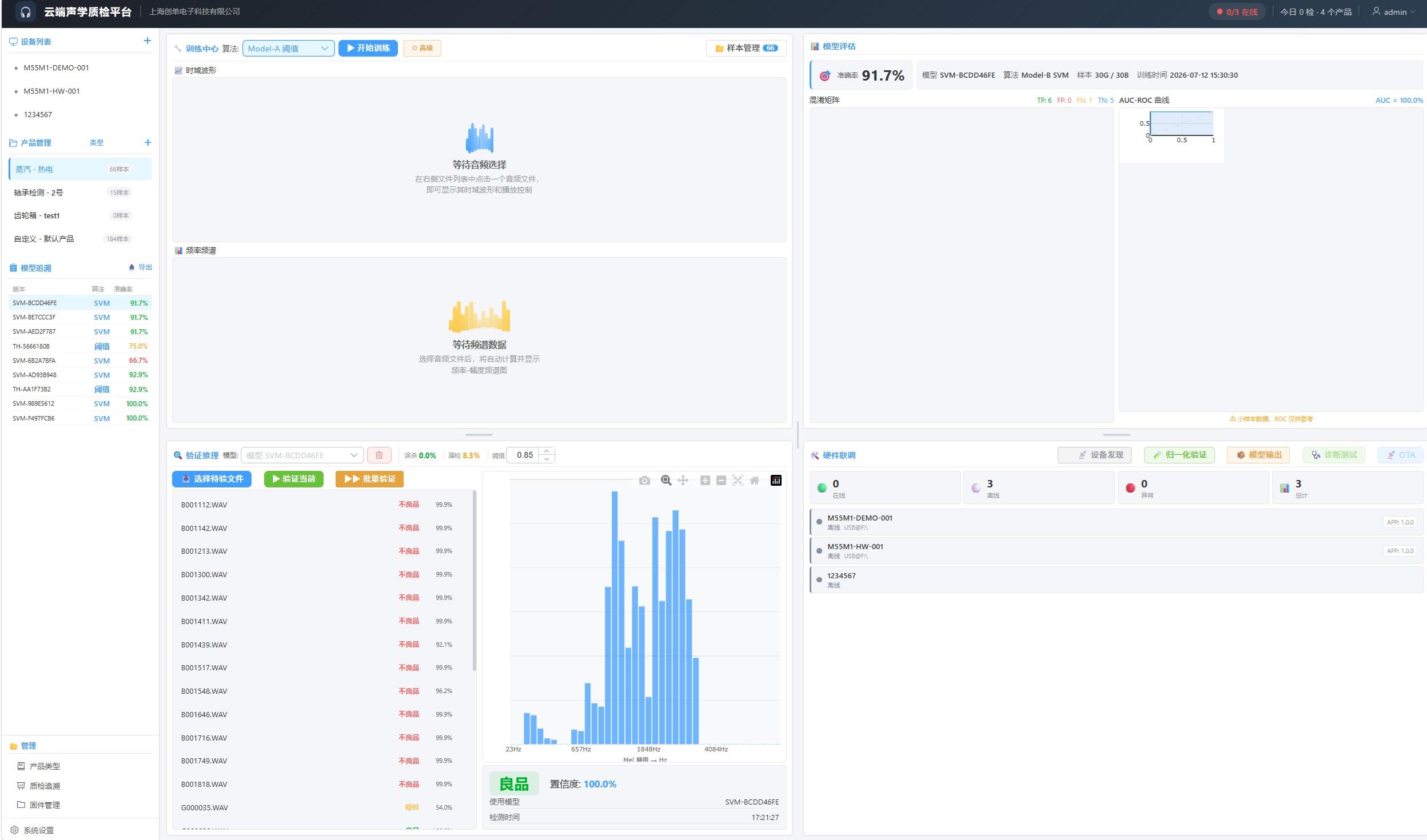
The inspection station runs on an ARM Cortex-M7 MCU with a fully CMSIS-DSP-optimized edge AI pipeline:
• AI Mode: 88-dimensional Mel-frequency spectral coefficients (MFSC) + SVM classifier → Pass/Fail + confidence % (e.g., "NG, Confidence 91%")
• Threshold Mode: Rule-based frequency-band energy judgment, no defective samples needed; technicians can see exactly which band exceeded limits
A physical toggle switch on the base enables one-second mode switching. The light ring changes color synchronously (Blue = AI, Red = Threshold), so floor operators always know which logic is active—no screen required.
Two Form Factors for Every Scenario
Online Full-Inspection
Target Scenario:High-speed automated lines
Key Difference:No screen/LED, direct PLC I/O, trigger-to-measure, lowest cost
Offline Sampling
Target Scenario:Anechoic chambers / lab benches
Key Difference:2.4" screen + status LEDs, debug mode with waveform/spectrum view